Sunday, June 16, 2013


Technology Timeline from 1840-Now
 
35mm Camera
1925
 
 
Photo by: Thorsten Overgaard
 
The 35mm Camera was invented by Oskar Barnack who was searching for a way to make cameras more portable.  This invention had a huge impact on photojournalism by allowing photographers to be mobile with their work.  This gave them an open canvas so to speak with what they wanted to take images of.   Photographers were no longer limited to where their camera would allow them to go.  The Wall Street journal said this camera was a development that "took photography out of the studio and into the streets." (Clark, Reference)
 
35mm Color Film 
1963
 
 
Photo by: Nick Selway
 
The first color photograph was produced in 1861 by James Clerk Maxwell.  The 35mm film was modified to enhance it's capabilities including color.  In 1963 Polaroid came out with instant color film.  This was a major milestone for photojournalism.  Images could now be replicated to show what the photographer is seeing with their own eyes.  Color film has allowed for photojournalism to truly capture and reflect a moment in time.  People do not see things in black and white, they see in color. 
(National Geographic, Reference )  
  
Photo CD
1990
 
 
 Photo taken by: Kodak
 
Photo Cd's were created in the late 1900's and they enable people to view their pictures on televisions and computers.  These photo CD's impacted photojournalism by allowing the images to be reproduced in a more efficient way.  All of your images are saved on to these discs that allow you to save and share your images.  These CD's have allowed journalists to have a library of pictures on such a small, compact disc.  I can't remember how many times I lost a 5*7 printed image that I would have loved to be able to pop this CD into my computer and the photo CD would have allowed me to re-create that image. 
 (Reference)

Digital Camera
1991


Photo taken by: Martin Pot
Image Source 

 The first digital camera was produced in 1991 and was targeted towards photojournalists.  When an image is captured and it "records light electronically and saves it in bits and bytes using the pixel grid (Tolmachev)."  Your computer then reads these bits and bytes and converts into the original image recorded.  The invention of the digital camera was probably had one of the largest impacts on photojournalism.  Digital photography is easy, even a small child could take pictures using a digital camera.  These cameras allow the average person, without any knowledge whatsoever on photography, to become their own photographer.
(Reference)
 
Cell Phone Cameras
1997

 
Photo taken by: Daniel Ortiz
Image source: Chester, Ma

Today's society seems to revolve around technology.  Everywhere you look someone is either taking on their cell phone or texting away.  Just about everyone over the age of 12 has a cell phone with almost all equipped with a built in camera.  Over the years these cameras have been improved, and they now take sharp, focused pictures.  In June of 1997 the first camera phone was invented by Philippe Kahn.  This has allowed people to become journalists in their own individual way.  Cell phone cameras have impacted photojournalism in both positive and negative ways.  Now a days, just about anyone is enable with the equipment needed to be a photojournalist.  This is a positive thing because most people do not have expensive cameras but using a cell phone, they don't need it.  This has had a negative impact in privacy as well as digital camera sales.  Most people always carry their cell phones with them and are therefor always ready to capture the next image.
(Reference)

Friday, June 7, 2013

Cell Phone Cameras


Photo taken by using my iphone 5: Taylor Yergeau
Image source: Bash Bish Falls, Mt. Washington State Forest, Massachusetts

            Since the year 2000 it seems that almost everyone today has a cell phone.  The cell phones today have cameras capable of taking still images and videos.  This enables anyone with a cell phone to become a photojournalist.  Digital photography has had a major impact on photojournalism.  I think it has allowed someone who maybe never took photography classes, to capture an image, feel proud of their work and want to share this image with the world. In my opinion the changes from pre-digital technologies to digital technologies.

            Some may argue that cell phone cameras do not take high quality photographs.  It was very interesting to learn that Time Magazine used an iphone camera to document Hurricane Sandy.  Benjamin Lowy made a good point stating, "To “point and shoot” has been a liberating experience. It has allowed me to rediscover the excitement of seeing imperfections and happy accidents rendered through the lens of my handheld device (Lowy)."  Camera phones allow photographers to easily capture an image with a click of a button instead of worrying about things like lenses, shutter speeds, lighting, etc.

            Bob Zeller says "the invention of the tintype, which was a metal image, and the ambrotype, printed on glass, allowed for mass production of small photographs usually kept by families in wooden or glass cases (Niller)."  This enabled photographers to make unlimited copies and distribute them.  With digital photography you can store hundreds of images on your phone or computer and send them electronically.  You can also print out your photos using photo paper and your printer, or by transferring your pictures to places like CVS or Walgreens. 

            For me I wouldn't be able view all of my old memories, and life experiences if I didn't have my camera phone.  I carry my phone with me constantly and therefore always have a way to capture an image.  In life, many unexpected things arise and these usually make the best photos.  Even owning a digital camera didn't allow me to take that many photojournalistic images because I almost never had it on me when a candid moment came up.  Digital photography has been a huge leap in photography for some.  By using your camera on your phone, anyone can take photojournalistic images that arise in your daily life, regardless of how fancy your camera may or may not be. 


Photo taken using iphone 5 by: Donna Wright
Image source: http://designyoutrust.com/2013/04/iphone-5-photography-by-donna-wright/

 References-
Lowy, Benjamin  http://www.forbes.com/sites/jeffbercovici/2012/11/01/why-time-magazine-used-instagram-to-cover-hurricane-sandy/

Tuesday, June 4, 2013

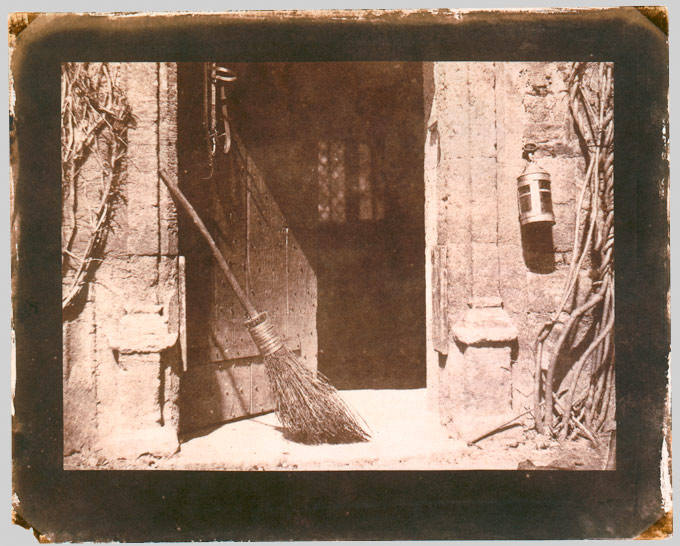
The Open Door
Photo by: William Henry Fox Talbot
Image source: http://www.metmuseum.org/toah/works-of-art/2005.100.498
Year: 1844

Quality of light: The light is very bold, the brightness on the outside brings your eyes right to the broom but past the door is complete darkness besides a small glass window visible.
Keep it simple:  The image is very simple with an old broom in front of an open door.  Although there are other objects visible in the picture like a light and some vines, your eyes are drawn right to the broom.
Contrast Appropriate: I believe the contrast of this photo is very high.  There are very bright areas outside of the door where the sun is shining, and very dark areas behind the door and where there are shadows.

I chose this image because it was kind of spooky and reminded me of Halloween.  This image looks like a photo of an old witches house.  The broomstick leaning on the wall in front of the open door sparks curiosity of what is inside beyond the light. I also thought it would be good examples of assessing a photograph using lighting principles.


Photo by: Dorothea Lange
Image source: http://marshallmatlock.com/2011/10/dorothea-lange-american-photographs/
Year: early 1900s

Keep it simple:  This is a very simple photograph with a boy smoking who is sitting down leaning back against a pole.  The image includes a boy, a pole and a cigarette, it is not cluttered at all in my opinion.
What feelings does this image create: I felt a little upset when viewing this photo.  Back in the early 1900's smoking was considered to be cool, and people were not aware of the health consequences and risks associated with smoking.  If this was an older man I don't think it would bother me as much as seeing this young boy smoking.
Is the image black and white or color: This image was printed in a time where only black and white was possible.  Regardless, I feel it has a stronger impact in black and white then it would have if in color.  The boy's cigarette is white and to me is what stands out in the picture.  I am not sure how well the cigarette would have stood out if it was competing with colors in the photo.

I decided to use Dorothea Lange's photo of the boy smoking because it sort of disturbs me.  Now a days smoking cessation is advertised like the way cigarette's smoking used to be before laws were created to stop this. Their are also laws that do not allow minors to purchase tobacco products. 


Photo by: Cal Williams
Image source: http://www.calwilliamsphoto.com/Scenic-Views/Nautical-Scenes/2016931_jpHk3g#!i=151725543&k=ms5PhSt
Year: 1999

Rule of thirds:  The sun is centered in this photograph but there is more to the photo then the sunset over water.  The photographer used the rule of thirds by capturing the leaves from the palm tree and a small boy in the left, outer third of the photograph.
Background compliments from composition:  With the background in such clear focus I think it helps complete the photo with the palm trees and small boy on the left of the photo.  They seem to compliment one another well, the boy and the background, and the photo would not be the same without one or the other.
What in the image helped to create that feeling: For me this image makes me feel at peace with the sun and the water.  At first glance I saw a beautiful water scenery but as time went by I began to notice the details and the image grew on me.  I saw that beautiful golden sun trying to shine through the giant cloud on the left.  I also saw the dark palm tree hanging over a boy who is squatted on the left, by the surf.

I came across this image and had to stop and stare at it so I decided to use it.  It is so beautiful with the water and the sunset glistening off the water and the bright blue sky.  I love the ocean so anything having to do with it I am into.  Something about this photo just fascinates me, I could stare at it for hours and still be intrigued.  The way the sun is shining behind that cloud, trying to make itself visible by the sky and water, is captivating to me.

Friday, May 31, 2013

Photo  by: Taylor Yergeau
Image source: Home, Springfield, MA

             A photo can be taken, and shared in different ways, such as printed films or digitally by phone or computer.  Over time there were a variety of different cameras that required different gauges for each specific camera used.  The 35mm color film was the first to be recognized as the international standard gauge.  Today it is the most commonly used gauge for still photography and motion pictures.  

Overtime the 35mm film was modified to enhance its capabilities now including both sound and color.   Compared to black and white films, color films were more real life to viewers’ eyes.   Color film has allowed people to visualize the original image captured in a more direct way.   Our world is full of color and color film allowed us to capture this.  Different colors in a photograph can also help the center of your focus to stand out against its background versus black and white film, producing different shades which can tend to blend together.  

Today’s technology now allows for photographs to be captured in a more convenient way; by disposable cameras, digital cameras and cell phones.  This allows photographers to capture images on the go.  My experience with photography is you usually have to capture the moment as soon as it arises because it doesn’t last long.  Personally, I always carry my Iphone and it takes great pictures and also allows me to view these images again, without having to pay for film printouts.  Sharing photos by sending digital images using the computer or my phone is also more convenient and it is free, versus developing pictures and then printing extra copies to  share.                                  


Sunday, May 26, 2013

When looking at a photograph for the first time you interpret the image in your own individual way.  A photograph can capture a moment in time and be re lived over and over again.  A person only experiences their life and through photos you are able to share a part of someone else’s life and what they were experiencing at that time. Certain images have been captured by photographers that will create a response of emotions in an individual and through these emotions that person may change.

Without these photographs people of the world would not be able to witness with their own eyes what this world is made of beyond what they haven seen.  Photographs have an impact on people that bring forth their own feelings which then promotes change in their behavior.  Johnathan Klein believed an image doesn’t change the world but rather creates reactions in people.  These reactions may then lead to change in the individual or larger movements affecting multiple people.  http://www.ted.com/talks/jonathan_klein_photos_that_changed_the_world.html   

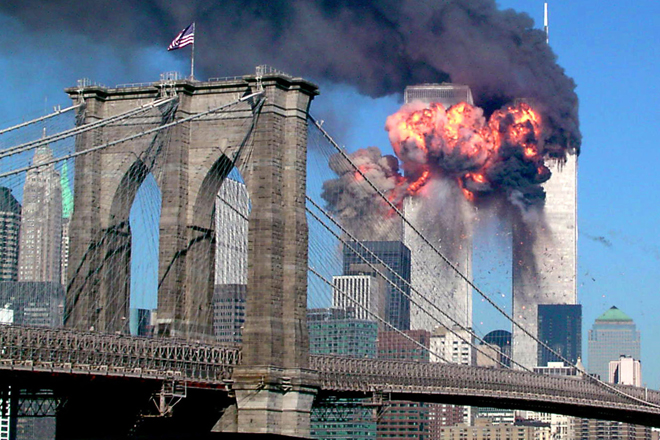
In my lifetime a tragic event that will remain a part of history is September 11, 2001.  This attack on United States soil and the countless lives lost started a War on terror.  This is an event that I witnessed through images and videos live when I was in middle school.  These photographs opened up the eyes of people in this world that innocent lives are taken everyday.
Photo taken by: Reuters
Image source: http://www.salon.com/2012/06/19/new_nsa_docs_reveal_911_truths/
 

Photo taken by: Thomas Franklin
Image source: http://mycrzylife.wordpress.com/2009/09/11/never-forget-2/

Through photographs people witness both good and bad things that consist of this earth.  This allows an individual to analyze this image and what is going on around the world and act based on their own beliefs.  Images freeze a moment in time and people react to these images.  Images that create positive emotions in people should be exposed more than negative images in hopes to create positives changes in people.  Sometimes you see someones else do something nice and it makes you want to repeat that feeling. 

Friday, May 24, 2013


Introduction to History of Photojournalism
           Photojournalism can be defined in many different ways.  I think that is something so unique because everyone has their own interpretation of what photojournalism is.  Professor Nordell divided the word photojournalism as two separate words photo and journalism.  This is such an interesting way to look at it because to me photojournalism is a story or journal about a photo.  The photographer is the journalist who captures a moment and shares it with the world.  The journalist has special skills that enable them to have a certain "eye" for looking at something.  They are able to capture an image that tells a story and this image causes feeling and emotions to arise in the viewer of this picture.

            The expression "a picture is worth a thousand words," helps to describe what photojournalism is to me.  A photo can be viewed by multiple people and each individual may feel and view this image in a different way, even though it is the same image they are viewing.  Viewing an image often causes a spark that makes you want to know more about this image.  Who took this why, when, where, how and as much information as you can retain.  It also sparks that mystery of not knowing what the photo is of or why someone would take this picture.
            It is important to know the history of photojournalism as well.  A moment is captured through a picture and it can be relived forever.  History is the foundation of the world.  If it wasn't for documentation through images or words we would not know what happened before our lifetime began.  Photojournalism is a great way to capture a story and make a footprint in history. 
Photo taken from NASA archives
Image source: http://rocketry.wordpress.com/2009/02/24/first-rocket-in-space-60-years-ago-today/

Photo taken by Charles C. Ebbets
Image source http://depletedcranium.com/were-steel-workers-really-this-reckless/


Photo taken by an unknown source
Image source http://eveningofthislife.wordpress.com/2011/05/02/to-pray-for-a-terrorist/


Statue of Liberty

Photo by Margaret Bourke-White
Image Source: https://topyaps.com/top-10-photographs-of-margaret-bourke-white/